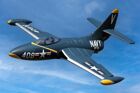
Freewing F9F Panther 4S Blue 64mm EDF Jet – PNP
The Grumman F9F Panther was one of the first jet fighters to serve aboard aircraft carriers. Its straight wings, wingtip tanks and compact, purposeful shape make it one of the most charming early-jet designs. Freewing captures that character in a 690mm EPO foam EDF jet, now finished in a striking blue livery.
This updated version is built around a 4S LiPo instead of 3S. Freewing has reworked the power system, the fuselage and the wing to make the most of the extra voltage. The result is a small jet with more speed, more punch and a much richer turbine-like sound.
Supplied as a Plug-N-Play (PNP) model, the F9F Panther comes with the motor, EDF unit, ESC and servos already installed. You simply add your own 4-channel receiver and radio.
Upgraded for 4S Performance
A new 2840-2850Kv brushless outrunner motor drives a 64mm 12-blade ducted fan. The higher blade count gives the Panther a smooth, convincing jet sound as it passes overhead.
Power is handled by a larger 40A ESC with internal BEC and XT60 connector. The ESC also offers a thrust reverse function.
To fit a 4S 14.8V 1600–2200mAh LiPo, the fuselage mould has been enlarged. The battery bay now has extra room for the bigger pack.
Stronger Airframe, Secure Canopy
The extra speed called for a sturdier structure. The wing mould has been revised to take a tubular spar, which gives the wing noticeably more strength.
The canopy is no longer held by magnets. A spring-loaded latch now keeps it firmly in place at high speed.
The durable EPO foam airframe uses nylon hinges on every control surface. These are more durable than simple foam hinges and keep control response consistent over time. The model is officially licensed by Northrop Grumman.
An Ideal First EDF Jet
The F9F Panther is a natural step for intermediate pilots who are ready for their first EDF jet. It is also quick and agile enough to keep experienced pilots entertained.
With a correct CG, the Panther glides for a surprisingly long time without throttle, which makes approaches relaxed and forgiving. It has enough power to loop and offers a lively roll rate.
The Panther is a belly lander, with optional landing gear available. Pilots new to EDF jets are advised to hand launch and to belly land on grass.
This is not a model for complete beginners. Start on a high-wing trainer and become comfortable with at least one low-wing aircraft before moving on to an EDF jet.
Plug-N-Play – Bring Your Own Receiver
The PNP configuration lets you use the radio system you already trust. Install a 4-channel receiver, bind it to your transmitter and set up the controls to your liking.
Always power the receiver and onboard electronics through the installed ESC and its integrated BEC, using the main flight battery. Do not use any other power source. The receiver, servos and onboard electronics are rated for a maximum of 5.5V.
Quick Assembly
Assembly takes about one hour, as the electronics and servos are already fitted. Before gluing the wing and fuselage together, sand the paint off the bonding surfaces so the glue achieves a strong joint.
Key Features
- Updated 64mm F9F Panther designed for 4S LiPo power
- Attractive blue livery
- Officially licensed by Northrop Grumman
- 2840-2850Kv brushless outrunner motor
- 64mm 12-blade EDF for a realistic jet sound
- 40A ESC with internal BEC and thrust reverse
- Enlarged fuselage to accommodate a 4S LiPo
- Strengthened wing with tubular spar
- Spring-loaded canopy latch for high-speed security
- Durable EPO foam construction
- Nylon hinges on all control surfaces
- Motor, EDF, ESC and servos factory-installed
- Glides well without throttle with a correct CG
- Capable of loops with a fast roll rate
- Belly lander, with optional landing gear available
- Plug-N-Play configuration without receiver
- Approximate assembly time of 1 hour
- Ideal first EDF jet for intermediate pilots
Specifications
- Wingspan: 690 mm / 27.2 in
- Length: 740 mm / 29.1 in
- Flying Weight: approx. 706 g / 24.9 oz
- Material: EPO foam
- Motor: Brushless 2840-2850Kv outrunner
- EDF: 64mm 12-blade
- ESC: 40A, internal BEC, XT60 connector
- Battery: 4S 14.8V 1600–2200mAh LiPo with XT60 connector
- Receiver: Not included
- Radio: 4-channel, not included
- Servos: 9g plastic, installed (elevator with 100mm lead; left and right aileron with 300mm leads)
- Controls: Ailerons, elevator, throttle
- Rudder: No
- Flaps: No
- Lights: No
- Landing Gear: None, belly lander (optional gear available)
- Hinge Type: Nylon hinges on all control surfaces
- Skill Level: Intermediate
- Completion Level: Plug-N-Play
- Recommended Environment: Outdoor
- Approximate assembly time: 1 hour
- Age: 14 and up
What's Included
- Freewing F9F Panther 4S Blue 64mm EDF Jet PNP
- Factory-installed servos and electronics
- Installed brushless motor, 64mm 12-blade EDF and 40A ESC
Required to Complete
- Minimum 4-channel transmitter
- Minimum 4-channel receiver
- 4S 14.8V 1600–2200mAh LiPo battery with XT60 connector
- 4S-compatible LiPo charger
Receiver, transmitter, battery and charger are sold separately.
F9F Panther 4S – Ready for Your Radio at Aerobertics
The Panther was a pioneer of carrier jet aviation, and this blue Freewing replica brings its classic early-jet lines to your local flying field.
The upgraded 4S power system, 12-blade fan, strengthened wing and secure canopy latch make this compact EDF faster and tougher than before. Its forgiving gliding character keeps it approachable.
At Aerobertics, we think the F9F Panther is one of the best ways to step into EDF jets. It is quick to assemble, easy to transport and great fun to fly.
Fit your receiver, charge a 4S pack and hear that 12-blade fan sing.